With our understanding of evolution and through a lot of science fictions, we now know life as a process can’t be confined only to Earth. Through scientific research, it is understood that extra-terrestrial life is not just possible, but inevitable. The evolution of life on any other part of our universe depends on a planet’s topography.
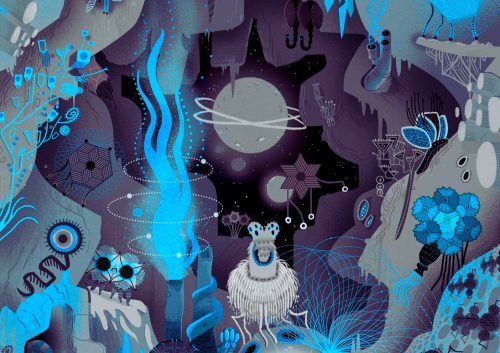
But the evolution of senses in the sequence we saw before can be safely assumed to be similar to that of Earth’s, with single-sensed organisms evolving first, leading to six-sensed beings who might end up asking the same question we face now, ‘what’s the point of all this?’. In all those alien life forms, the law of karma can/will act in the same way as it does so here on Earth.
Types and Times of Karma
The Yogic and Siddha philosophies talk about 3 types of karma we go through during our lifetimes: Sanchitta karma, Praraptha karma and Aahmya karma.
The first type, Sanchitta karma, refers to all karma a soul inherits from its predecessors. To simply put it, every living being carries a genome through which it inherits its parent’s characteristics. The genome (DNA/RNA) has all the functional traits of the physical body (including its mental capabilities) of an organism. Usually, over successive generations, the most dominant characteristics (both physical and mental) dominate over the others so that the organism can survive at least until it reproduces.
These characteristics are not just part of the single generation of parents, but also the parents’ predecessors. In humans, like we inherit the physical and mental characteristics of the physical body, we also inherit karma from our parents. The Sanchitta karma refers to this inheritance from not just one previous generation, but 6 generations before our parents! Each of us inherits karma from one male and one female individual (parent generation), and our parents inherit karma from their parents, which totals the number to 6 (2 first generation and 2+2 second generation) individuals.
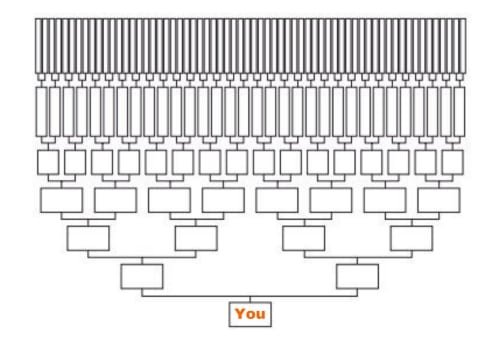
This way, we can calculate that we carry the karma of a total of 126 people at the time of our birth. However, this shouldn’t be considered a bad sign. We now know that karma, the consequential force, can either be good or bad and both, and it depends upon the thoughts and actions of individuals. When a new soul is born, the totality of both good and bad karma of the 7 previous generations are imprinted upon it, which affects the soul’s life in its future, just like the physical and mental characteristics decide how an individual performs.
So, an offspring inherits karma from 7 previous generations or in other words, the consequences of any action of any individual from the 7 previous generations can be felt by the last offspring in his/her present life!

The Praraptha karma is generated through the thoughts, words and actions done in our present life. Our story of the car accident explains how Praraptha karma works in people’s lives. While Sanchitta karma is concerned with the past of a soul, the Praraptha karma is confined to the present actions of the soul, the future of the soul is bound with the Aahmya karma, which interferes with our futures by expressing itself as thoughts, actions and repercussions of actions at any point of time in the future!
Karma should be understood as a balancing force of life rather than an unavoidable pestilence. The law of karma works its way through every living being irrespective of what one might believe in! One of the best ways to observe karma in its operation is to have a good memory of our attitudes during our past actions, and we’ll observe the same attitudes being reflected from others in our future.
Though the exercise is quite hard to be worked out, our chances of observing karma can be improved by constant vigilance of thoughts and actions.