Time being absent inside the energy medium, the singularity formation could’ve taken place in an instant! The build-up of pressure in the energy, conversion of pressure into heat, and the point becoming smaller than the size of an atom, all these processes could’ve happened instantaneously!
But this appears to be a paradox! If energy had transformed into heat, it could be said to have gained momentum and, by our condition, when it gained momentum, time must’ve definitely begun. Energy, by our definition, is a static medium. With pressure and heat being dynamic effects of energy, the instance where momentum was gained by energy when it started compressing upon itself could be the possible beginning of time. Thus, time could’ve preceded the singularity (and the Big Bang) itself, at least by a few microseconds! And so began the cosmological arrow of time, which is supposedly the first arrow of time of our universe.
The cosmological arrow is the same as the thermodynamic time, wherein the ordered state of the energy converted itself into the disordered state of singularity and consequently, the Big Bang. With the beginning of chaos from order, the events that followed suit could’ve had only one possible direction of flow (of energy), onward and not backward! The singularity reached a critical point, below which no more energy could be compressed into it. Upon reaching this critical limit, the Big Bang occurred.
The Big Bang, the Mass and Forces
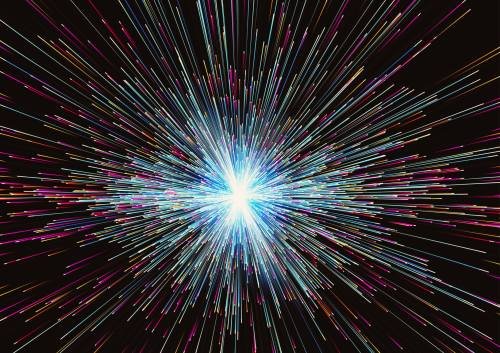
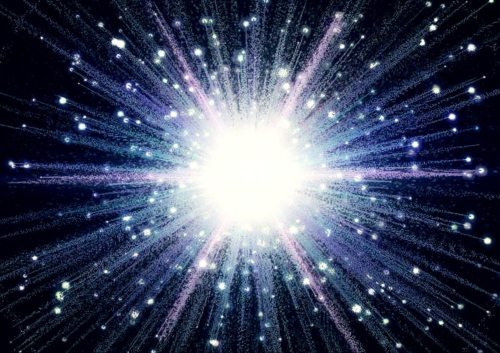
The singularity exploded, and in an instant, the energy trapped inside the point started spreading into the energy medium around it. The super dense energy now started to push across the infinite field of energy and imposed momentum into it. The result was that the surrounding energy medium started gaining momentum and converted itself into the different levels of energy we saw earlier.
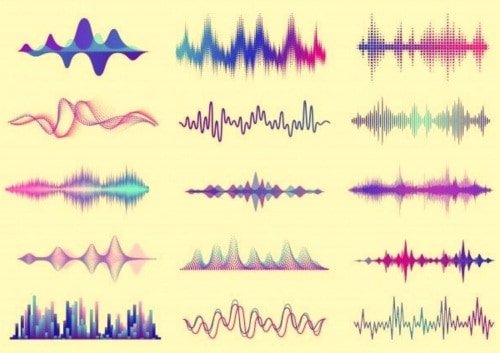
First came the waves, little disturbances in the energy which escalated into becoming the vibrations. The waves are not the typical characteristics exhibited by the subatomic particles but were disturbances in the energy medium when it started moving, or in other words, when sheets of energy started bending up (in all directions), waves were born, and when the waves intensified, they became vibrations. The vibrations sped up further and reached the mass level. But, this transformation wasn’t as abrupt as we think.
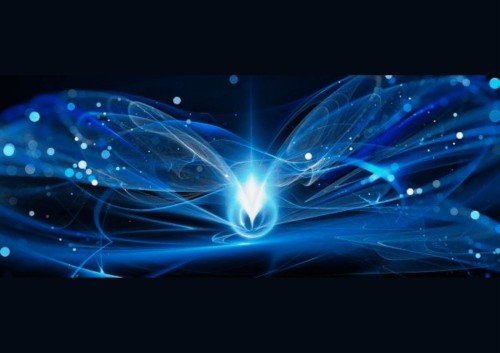
In between the vibration and mass levels, the energy attained the intermediate stage where it appears to gain mass. This stage is known to be the Higg’s Boson. Our popular understanding is that the Higg’s Boson provided mass to the particles, but when viewed from the energy side, it appears that the vibrations escalated to gain mass and in the middle of the process became the bosons.
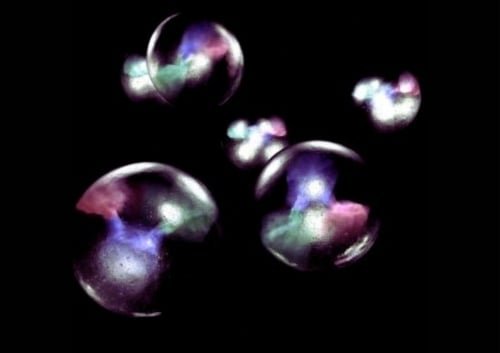
After the Boson stage, the vibrations gained a well-defined mass our currently known groups of particles (quarks and leptons) surfaced with each gaining a specific mass. The particle formation was random with different amounts of energy forming particles of different sizes. Although the Leptons were quite similar and stable, the quarks varied greatly in terms of their mass. Some of the heavier quarks like Top, Bottom, Charm and Strange broke down as soon as they formed and became the Up and Down quarks.
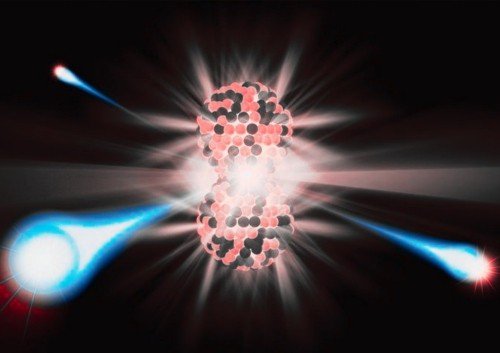
After our known subatomic world appeared, some of the particles accelerated further to become the forces. Like we saw earlier, when any particle, be it an electron or an Up quark or a tau neutrino, was pushed beyond its original momentum level to accelerate further, it went on to become the force carriers. When a particle’s acceleration doubled, it became a graviton, and when it tripled, it became a W or a Z boson. When it reached even greater momentum levels, it became photons and gluons.
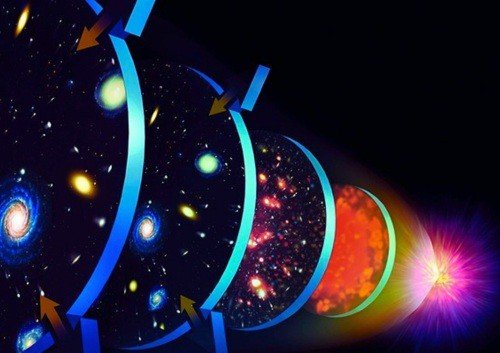
Each of these force carriers later interacted with mass to form the forces of gravitation, electromagnetism, weak and strong nuclear interactions. Once the particles reached the force levels, they wouldn’t lose their momentum down to become mass again. So, they stayed on as the force carriers! This process of energy gaining momentum and converting into particles and force carriers happened within an unimaginably small time; one trillionth of a second after the Big Bang!
With energy gaining momentum for the second time (after the Big Bang), this time forming mass and forces, the energy medium was getting increasingly pushed around within a short range of the Big Bang region. This region, where energy got transformed into mass and forces was growing empty and it grew into space, with its 3 major dimensions.